
Features
Why Choose BELAN?
Multi-Axis CNC Precision Control
Advanced multi-axis CNC systems enable precise coordination of feeding, bending, rotating, cutting, and forming processes. This ensures accurate geometry, consistent quality, and stable production performance for complex wire components.
Customized Wire Forming Solutions
Belan provides customized forming solutions based on different wire materials, product structures, and production requirements. From automotive components to special wire parts and busbar applications, we help customers select the right machine configuration for their needs.
High Accuracy & Repeatable Production
Servo-controlled systems and precision mechanical structures deliver excellent feeding accuracy and bending consistency, helping manufacturers maintain stable product quality during continuous production.
Integrated Automatic Forming Process
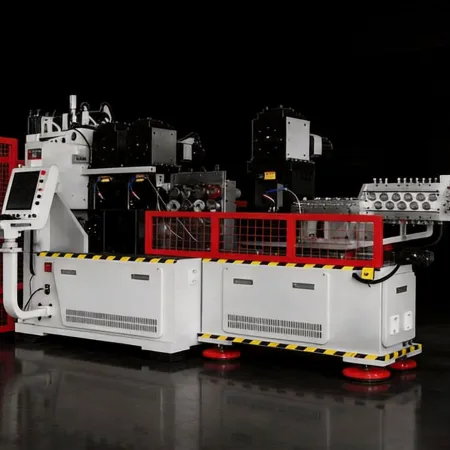
Belan machines integrate multiple processes including wire feeding, straightening, bending, rotating, cutting, and forming into one automated workflow, reducing manual operations and improving overall production efficiency.
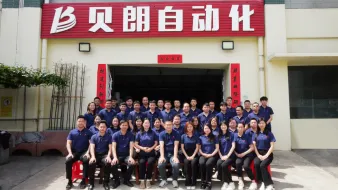
We Have The Best Solutions for Your Business
DONGGUAN BELAN AUTOMATION EQUIPMENT CO.,LTD stands at the forefront of the global wire forming industry. Located in the manufacturing heartland of Dongguan, we specialize in high-end 2D and 3D wire forming solutions that merge German precision with Chinese agility.
By integrating advanced CNC technologies from Japan and Korea, we have solved the industry's most persistent challenges: achieving micron-level precision while maintaining high-speed production stability.
Wire Bending Machine: Types, Specifications, and Selection Guide
Introduction
On a production floor, the difference between a profitable wire component and a costly one rarely comes from a single dramatic factor. It is usually the accumulation of small, repeatable details — a bend that lands within tolerance on the first piece and the ten-thousandth, a setup a new operator can repeat without relearning the machine, a line that holds its accuracy through a full shift. A wire bending machine sits at the center of that equation for countless metal parts, and selecting the right one shapes cost, quality, and throughput for years.
This guide explains what a wire bending machine is, how CNC models turn a program into formed parts, the main machine types available, the specifications that actually affect production, and how to evaluate a machine against your own components.
What Is a Wire Bending Machine?
A wire bending machine forms straight or coiled wire into shaped components by bending it to programmed angles and radii. At its core the process is straightforward: feed the wire, position it, bend it, cut it, and repeat. What separates a capable modern machine from a basic one is the control system behind those steps and the tooling that shapes the material.
In a manual or semi-automatic machine, the operator sets mechanical stops, adjusts tooling by hand, and checks each bend against a sample. In a CNC wire bending machine, those steps are programmed. The controller drives servo axes that feed, rotate, and bend the wire to a stored program, so the same part is produced the same way on every cycle. The result is less dependence on operator skill and far tighter consistency across a production run. For a direct comparison, see our article on automatic wire bending machines versus manual forming.
How Does a CNC Wire Bending Machine Work?
A CNC wire bending machine converts a part program into coordinated servo motion. The typical sequence begins with wire fed from a spool or straightener into the bending head. The feed axis advances a precise length, the wire may be rotated around its own axis to present the correct bending plane, and bending tools then form the feature. The sequence repeats for each bend, and the finished part is cut and ejected.
Accuracy depends on two things working together: how precisely the machine holds wire position, and how consistently the tooling forms the material. The controller can repeat axis positions to tight tolerances, but the final part shape is set where the wire meets the tooling. This is why machine precision and formed-part accuracy are related but not identical — and why tooling, wire support, and setup discipline matter as much as the servo system. For a step-by-step view of the forming cycle, see our article on how a CNC wire bending machine works.
Most wire materials recover a small amount after the bend is released — a behaviour called springback. CNC machines address this by calculating the over-bend required and holding it in the program, and more advanced systems refine the correction with sensor feedback or AI-assisted compensation that adapts to variation between material batches. Stable springback handling is what keeps bend angles consistent across thousands of parts without an operator re-correcting each one, and it is a major reason CNC accuracy outperforms manual setups on long runs.
Types of Wire Bending Machines
Wire bending machines are commonly grouped by the geometry they can produce and by how the bending head is arranged.
- 2D wire bending machines — form parts that lie essentially in a single plane, such as brackets, clips, shelves, and simple frames. They are compact and fast for flat shapes, and often the right choice when the part never leaves one plane. See the 2D wire bending machine overview.
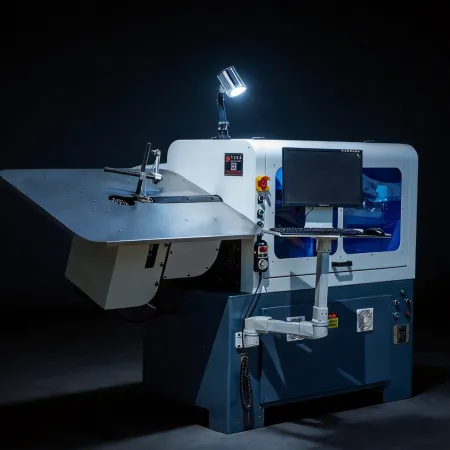
- 3D wire bending machines — add rotation and additional axes so the wire can be bent in multiple planes, producing seat frames, complex automotive wire, and three-dimensional forms in one uninterrupted setup.
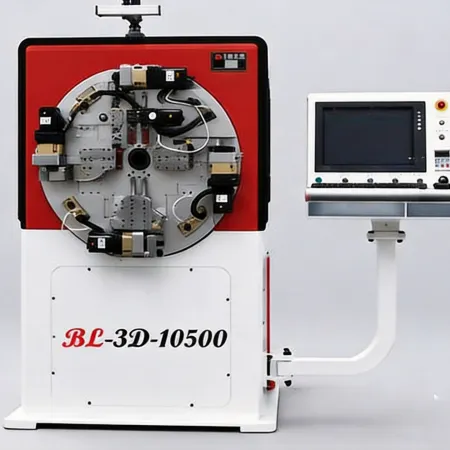
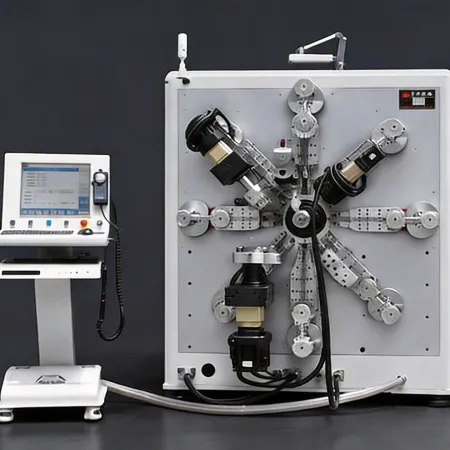
- Rotary head machines — rotate the bending head around the stationary wire, enabling high-speed multi-plane forming with smooth transitions between bends. See the rotary head CNC wire bending machine.
- Double head machines — form both ends of a part at the same time, which suits symmetrical components and can roughly halve the forming cycle for the right geometry. See the double head wire bending machine.
The choice between these types is not about which is more advanced — it is about matching the machine architecture to the part. A flat bracket does not need a 3D machine, and a three-dimensional seat frame cannot be made on a 2D one. The article comparing 5-axis and 6-axis CNC wire bending machines explains how axis count changes what a machine can form.
Key Specifications That Matter
When evaluating a wire bending machine, a long specification sheet is less useful than a short list of figures that actually predict production performance.
- Wire diameter range — the minimum and maximum wire the machine can feed and bend reliably, which also sets the forming force requirement.
- Bending accuracy and repeatability — how closely the machine reproduces angles and dimensions part to part, usually expressed as a tolerance band.
- Number of axes — more axes generally mean more complex geometries can be formed in one setup without manual repositioning.
- Feed speed — how fast the wire advances, a major driver of cycle time for high-volume runs.
- Tooling and changeover — how quickly tooling can be swapped and the machine reconfigured between parts.
- Production volume and machine configuration — whether the machine is built for intermittent batches or continuous mass production.
Among these, wire diameter and bending accuracy tend to govern everything else. They determine the machine frame, the servo size, the tooling design, and ultimately the part quality. Specifications should therefore be read as a connected system rather than isolated numbers, and confirmed by trial forming on production wire before commitment.
Common Wire Materials and How They Affect Bending
The wire itself is half of every bending decision. Carbon steel, stainless steel, copper, and aluminum behave differently against the same tooling, and each brings its own challenges.
- Carbon steel wire — comparatively stiff with pronounced springback, so tooling must support it firmly and the working radius must be compensated for recovery.
- Stainless steel wire — tends to work harden during forming, requiring stable, well-distributed contact and consistent force to avoid surface and dimensional issues.
- Copper wire — soft and ductile but marks easily, so tool contact surfaces need particular attention to avoid cosmetic defects.
- Aluminum wire — lighter and lower in strength, and can be marred by tooling configured for harder materials.
Wire diameter matters as much as material. Larger diameters demand greater forming force and stiffer support, and magnify any clearance or alignment error. Fine wire is more sensitive to guiding precision and tool surface finish. Tooling, clearance, and support must be matched to the diameter range actually being run, not to a generic setting.
Applications Across Industries
Wire bending machines serve a broad range of industries because so many products contain shaped metal wire. In automotive manufacturing they produce seat frame wire, foam wire, seat support structures, linkage components, and exhaust hanger parts at very high volumes. In furniture and hardware they form shelf hooks, display racks, and functional brackets. Appliance, enclosure, and medical device makers use them for frames, guards, and precise formed details.
The requirements differ by sector. Automotive production stresses repeatability at volume and tight tolerances because dimensional errors accumulate in downstream assemblies. Furniture and hardware often prioritize fast changeover across many SKUs. Understanding which of these pressures dominates your work is the first step in specifying the right machine. BELAN's industrial wire forming solutions describe how machine and tooling configuration are matched to the application.
How BELAN Approaches Wire Bending Machines
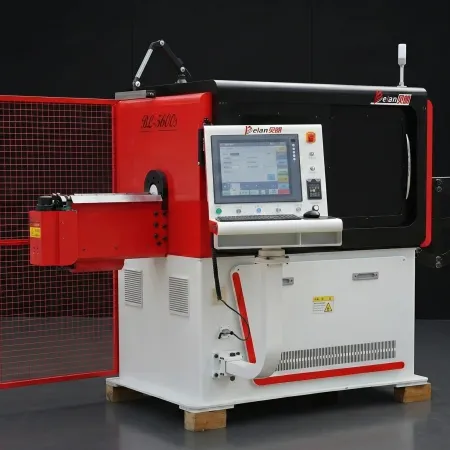
BELAN Machinery builds multi-axis CNC wire bending machines for manufacturers that need repeatable accuracy across demanding wire geometries and materials. Drawing on experience in CNC wire bending, AI-assisted springback compensation, and high-volume automotive wire forming, the engineering workflow starts from the part rather than from a standard machine.
- Review the part drawing and define every bend, radius, and tolerance
- Confirm the wire specification — material, diameter, and temper
- Select or design tooling around the part geometry, including custom tooling where a unique radius or material requires it
- Configure the machine architecture to match the forming concept
- Trial form with production wire and measure the result
- Lock the proven tooling and parameters for repeatable production
Where a unique bend radius, special material, or complex sequence takes the requirement beyond standard tooling, BELAN designs custom tooling and machine configurations for that specific combination. The decision is driven by the forming requirement, never the reverse, and the same logic extends to bespoke setups developed around a customer's parts and production volume.
Wire Bending Machine Selection Checklist
- ☐ Define the wire material and diameter range you will actually run
- ☐ List every bend, radius, and tolerance from the part drawing
- ☐ Decide whether the part is 2D or 3D, and how many planes it spans
- ☐ Estimate production volume and the required cycle time
- ☐ Confirm the accuracy and repeatability your assembly demands
- ☐ Review tooling changeover needs across your SKU mix
- ☐ Check space, power, and upstream handling (spool, straightener)
- ☐ Request trial forming on production wire before commitment
- ☐ Verify after-sales support, training, and spare parts availability
- ☐ Compare total cost of ownership, not just the purchase price
Conclusion
A wire bending machine is only as dependable as the system around it — the program, the tooling, the wire, and the discipline of the setup. The manufacturers who get lasting value are the ones who match machine architecture to the part, validate specifications by forming production wire, and treat tooling as an engineered element rather than a commodity. Done well, the machine stops being a source of variation and becomes a predictable, repeatable foundation for the whole production line.
Whether the requirement is a simple 2D clip or a complex 3D automotive component, the path is the same: start from the part, confirm the material and tolerance, and choose a machine and tooling combination that can hold those specifications across the full production run.
Ready to Evaluate a Wire Bending Machine for Your Parts?
BELAN Machinery, a professional provider of CNC wire bending and forming solutions. Send us your product drawings and wire specifications, including diameter, material, and bend requirements. Our engineering team can evaluate your forming needs and recommend a suitable machine and tooling configuration.
Contact Belan for a Feasibility AssessmentRelated Resources
- CNC Wire Bending Machines — Overview of BELAN's multi-axis CNC wire bending equipment for high-precision wire forming.
- Automatic Wire Bending Machine vs Manual Forming — Why CNC consistency matters for production quality and throughput.
- How to Choose a CNC Wire Bending Machine — A deeper buying guide covering specification, tooling, and vendor evaluation.
- 5-Axis vs 6-Axis CNC Wire Bending Machines — What axis count actually changes about the parts you can form.
- Industrial Wire Forming Solutions — Application-specific configurations where machine and tooling are matched to the part.
- CE Certified Wire Bending Machines — Why compliance matters for the European market and export projects.
Featured Products
Collection about BELAN
User Reviews
What users say about BELAN
Frequently Asked Question
Do you have any question?
Our updates and blog posts
Busbar Bending Machine: CNC Precision Engineering for Modern Power Distribution Manufacturing
Complete guide to CNC busbar bending machines: types, components, materials, bend types, applications, quality standards. Belan TP Series. CE and ISO 9001.
Busbar Bending Machine: CNC Precision Engineering | Belan
CNC busbar bending machine technology: servo-hydraulic systems, closed-loop angle measurement, springback compensation, CAD integration. Belan TP Series.