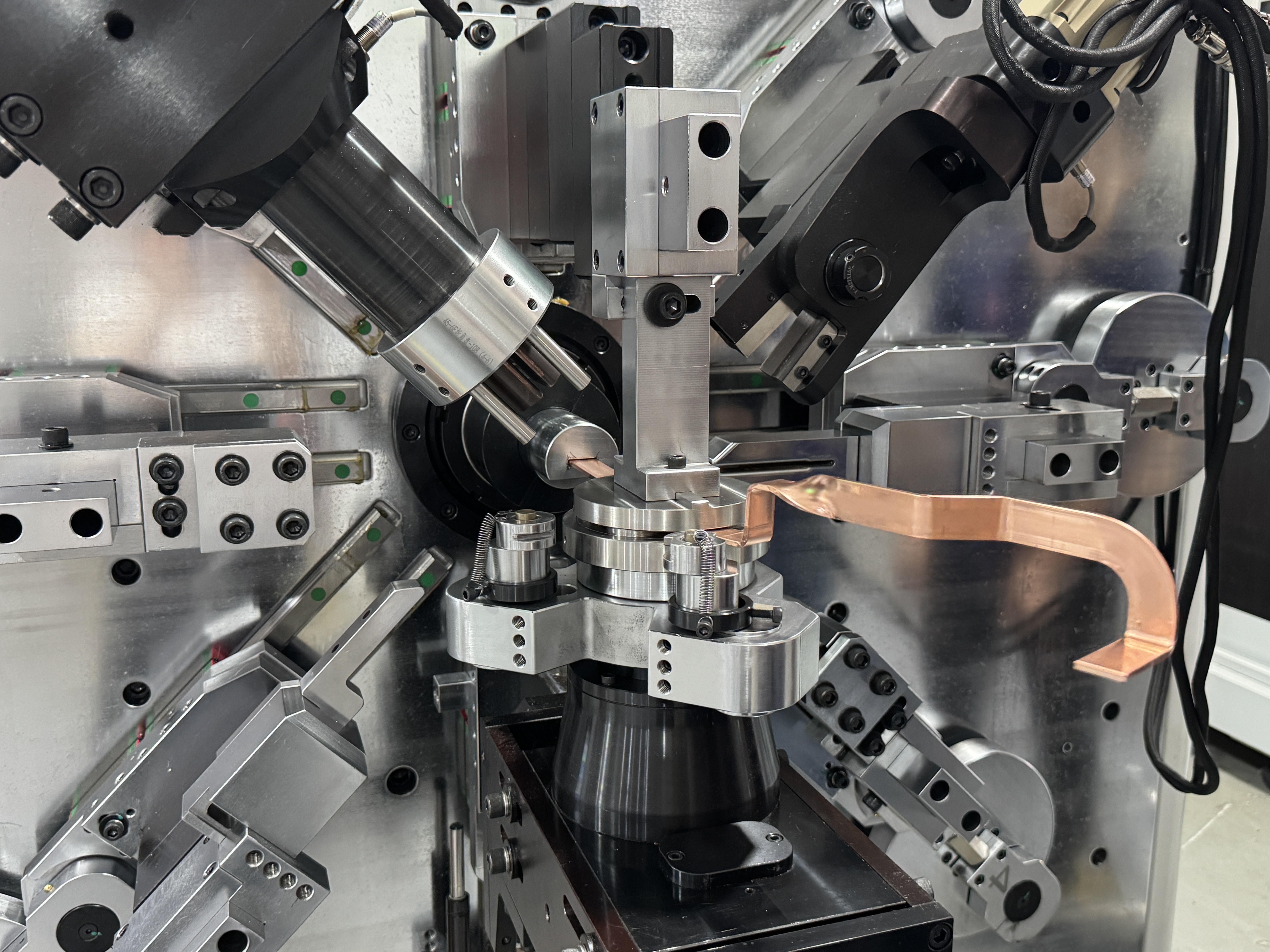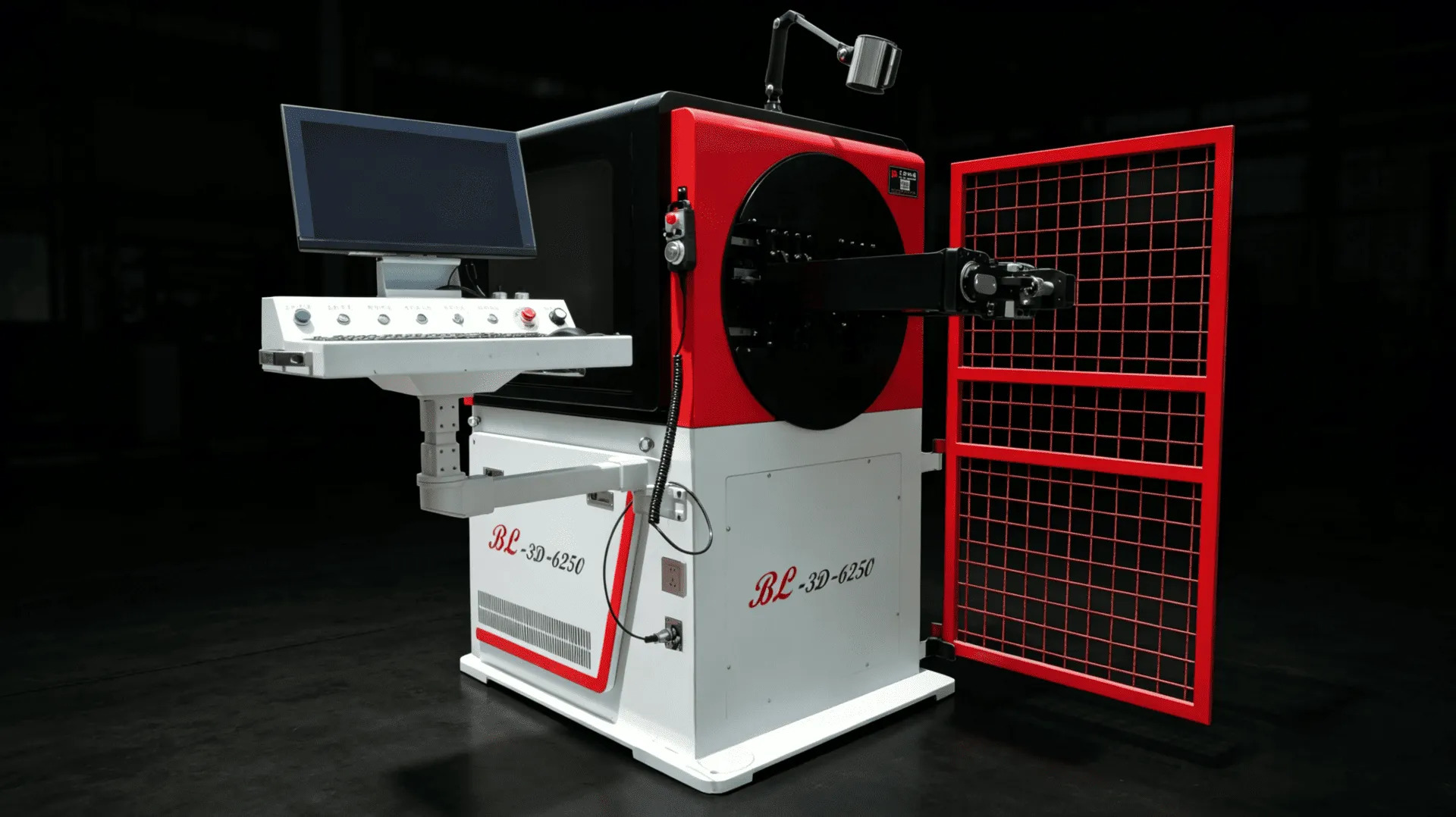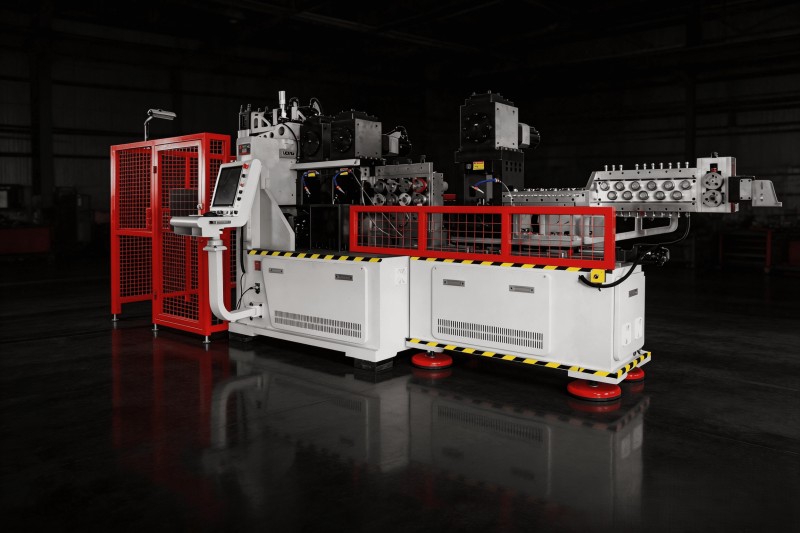


Motor lead wires, sensor pins, transformer tap leads — the drawings look simple, and the shop floor disagrees. Enameled copper wire bends easily; the enamel is what turns the job into a project. Bend first and strip later, and the parts leave your plant for offline stripping or get ground by hand: extra handling, damaged copper cores, dust nobody wants near a winding shop, and a second tinning step before the ends can be soldered. We took a different route on our CNC wire bending machine series: straighten, strip, clean, tin and bend — one pass, one machine.

The Hard Part Is Not the Bend — It Is the Enamel
Ask anyone who has subbed out stripping. The parts travel, they get scratched, the strip length drifts from batch to batch. Hand grinding eats into the copper. Dust settles where it should not. By the time an end is solder-ready, the process has touched the part four or five times — and every touch is a chance to scrap it.
Five Operations, One Machine
Straightening and Feeding
Spool wire passes through a straightener first. The BL-3D-10300 feeds at up to 80 m/min, the BL-3D-10500 at 50 m/min. Fine wire wants stability, heavier wire wants torque — the two machines lean in opposite directions on purpose.
Strip Before the Bend, Not After
Stripping happens before forming and only where it is needed: the solder end. Servo-controlled peeling axes remove the enamel without cutting the copper, and the dust is extracted immediately — off the guideways and off the part. That is what an enameled wire bending machine is built around: tooling designed for the coating, not working against it.

Ends That Arrive Solder-Ready
Stripped ends go through tinning on the way out. The parts reach your assembly bench ready to solder — no rework loop, no second handling.
Rotary Forming
Forming runs on a rotary table: hooks, rings, coils and 3D angles in one setup. Fine enameled wire from 1.0 mm up handles clamping far better in a rotary head than in a cantilever bend — less scratching, less springback.
BL-3D-10300 or BL-3D-10500?
Both are 10-axis machines. The split is wire range and configuration, and the figures come straight from our product pages:
| Item | BL-3D-10300 | BL-3D-10500 |
| Applicable wire | Soft Φ1.0–4.0 mm / hard Φ1.0–2.5 mm | Enameled copper Φ1.0–5.0 mm |
| Axes | 10 | 10 |
| Total power | 9.75 kW | 10.65 kW (full servo) |
| Feed speed | up to 80 m/min | up to 50 m/min |
| Machine weight | 2,000 kg | 2,280 kg |
| Typical parts | Motor coils, transformers, inductors, relays | Motors, transformers, solenoid coils, automotive electrical parts |
One line to choose by. If your wire stays under 4 mm, is mostly soft, and cycle time rules the shop, the CNC wire bending machine for enameled wire — the BL-3D-10300 — is the faster feeder. If you form enameled copper up to 5 mm and stripping-plus-tinning is a hard requirement, the BL-3D-10500 is a 10-axis CNC wire bending machine that carries its peeling axes as standard equipment, not a bolt-on.

Which Parts Fit a One-Pass Line
Not every enameled wire part justifies the line. We draw the boundary on three checks:
| Check | Fits one-pass forming | Does not fit |
| Wire diameter | Enameled copper Φ1.0–5.0 mm | Coated flat wire beyond the envelope |
| Volume | Thousand-piece lots, ongoing orders | Prototypes, a few hundred pieces a year |
| End treatment | Ends stripped, tinned or crimped | Fully coated, no exposed section |

Between the columns, send us the drawing and we bend a sample. Copper wire stripping and bending is not a hard process to watch — the difficulty is holding strip-length consistency, copper-surface integrity and solderability at volume. That is what a CNC wire bending machine holds steady, not operator feel.
Send the Drawing, We Bend One
If you are not sure your part fits, the cheapest test is a sample. Send the drawing or the part; we bend it, film it and quote the cycle time. For questions about a CNC wire bending machine for your enameled wire parts, talk to our engineering team directly.
BELAN Machinery, your expert provider of automotive wire forming solutions.