
Wire Forming · Applications & Shape Capability
A wire forming machine is defined less by its axis count than by the shapes it can hold and repeat. Here is how six industries use the same equipment platform in different ways — and how to tell which category your own part belongs to.
Direct answer: Wire forming machines turn coiled or cut wire into repeatable two- and three-dimensional parts — frames, hooks, brackets, racks, links and clips. Six industries buy them: automotive, furniture and hardware, kitchen and bath, home appliances, medical, and construction and retail display. The machine platform is often similar; what changes is wire diameter, bend count, surface sensitivity, batch size and how often the shape changes. Match your part to that pattern, not to an industry label.
What Defines an Application: Shape, Not Industry Name
When buyers ask what a wire forming machine is used for, the honest answer starts with geometry rather than with a sector. The same base machine, fitted with different tooling and programming, can produce a chair frame in the morning and a bracket in the afternoon. What separates one application from another is a small set of shape characteristics: whether the part is flat or moves through several planes, whether it is made from round wire or flat strip, how many bends it carries, and how tightly those bends must hold position.
The second characteristic is how often the shape changes. A plant that runs one geometry for half a million cycles has a very different problem from a shop that switches between twenty short batches a week. The first cares about stability over a long run; the second cares about how quickly a program and a tool set can be brought back into tolerance. Industry labels are a useful shorthand for these patterns, but they are not the cause of them. Read the part and the batch, and the right category of machine usually becomes obvious.
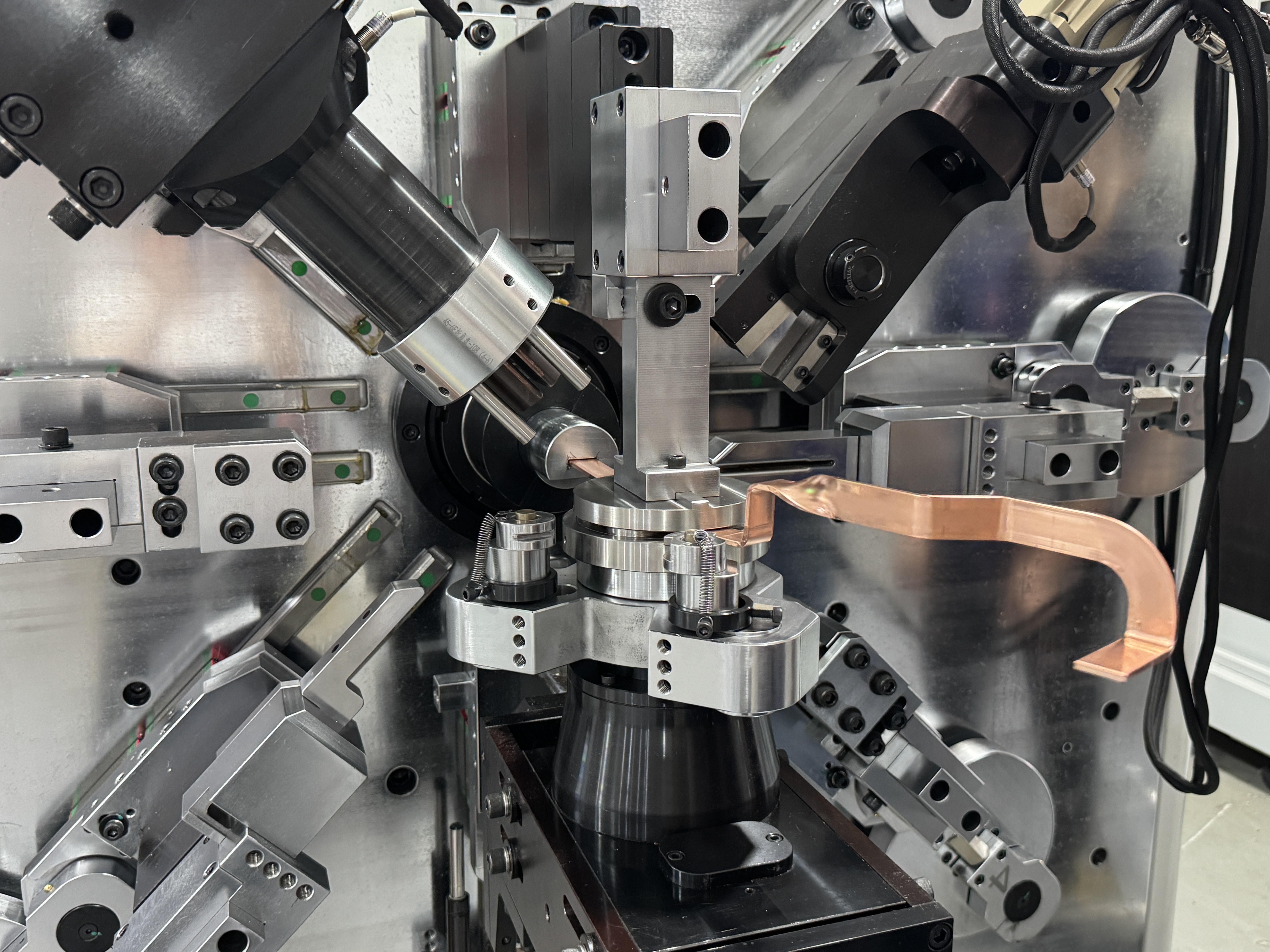
A flat two-dimensional piece stays in one plane and can often be formed on a simpler layout. A part whose bends leave the plane needs controlled head rotation, which changes both the machine and the cycle.
Round wire dominates springs, hooks and frames. Flat strip is common where a part must present a broad surface or carry a load. The two need different tooling and feeding behaviour.
Long single-shape runs reward automatic feeding and unloading. Frequent short batches reward fast program recall and repeatable setup above raw forming speed.
If you want to see how these shape categories translate into equipment, our article on choosing a machine for complex 2D and 3D components covers the boundary in more depth, while the two-dimensional machine range and flat-wire rotary equipment show where the two families diverge.
Automotive: Repeatability Matters More Than Speed
Automotive is the most demanding application category for wire forming, and the one people most often think of first. Typical parts include seat frames and foam-support wires, wiper arms and linkages, exhaust hangers, spring clips and reinforcement mesh. Wire diameters tend to be medium to large, and high-strength grades are common because the parts are structural or safety-related. The decisive requirement is rarely headline speed. It is the ability to produce the same geometry, to the same tolerance, across a run that may last for years and across more than one plant.
That is why automotive applications lean toward multi-axis and double-head configurations, and why integration into a larger assembly flow matters as much as the forming station itself. A wiper linkage that feeds straight into a downstream assembly avoids handling and preserves traceability; the same part made in isolation introduces an extra transfer and an extra chance of error. Our seat frame wire forming equipment, wiper rod forming machines and automotive wire mesh systems are built around that repeatability requirement.
The pattern is visible in real projects. A wiper arm forming line accepted on site and a fully integrated seat mesh line both show the same logic: form the part, keep it in flow, and hold the geometry. The double-head approach addresses the case where long wire rods or high volumes make a single head the limit.
Automotive is the most exacting of the six categories, but it is not the only one. The same forming platform is specified for furniture, kitchenware, appliance and display parts, where the priorities change even though the machine family does not. More on automotive component applications.

Furniture and Hardware: Changeover Is the Real Cost
Chair frames, shelf hooks, baskets and display stands belong to a category defined by variety. Wire is generally small to medium in diameter and often coated, and a single supplier may be asked to produce dozens of shapes in modest quantities. In this environment the cost that dominates is not the seconds per part. It is the time required to move from one shape to the next: recalling the program, changing tools and rollers, proving the first piece and bringing the geometry back into tolerance.
For that reason furniture and hardware applications favour two-dimensional and rotary-head machines with programming that an operator can use confidently. Maximum axis count is worth less here than a control that makes a repeat job quick to set up. Real installations illustrate the point: a 14 mm chair bracket machine and a rotary-head machine making shelf hooks are both chosen for shape flexibility rather than for a single high-volume part. The rotary-head range is the usual starting point when a product family changes often.
Kitchen and Bath: The Surface Is the Product
Racks, hooks, handles and drain baskets are visible in the finished home, so the surface carries as much value as the geometry. These parts use small-diameter stainless or coated wire, consistent radii and a finish free of tooling marks. A bend that is dimensionally correct but leaves a scar on the coating is a reject, which makes tooling condition and gentle feeding more important than raw forming speed.
The practical consequence is that kitchen and bath buyers should judge a machine by the quality of the tools it can carry and the way it handles coated wire, not by an advertised bends-per-minute figure. A kitchen and bath hardware installation shows how a compact rotary-head machine can move a manufacturer into accurate automated production without over-specifying the equipment. Where the part is made from strip rather than round wire, the flat-wire rotary design is the relevant family.
Home Appliances: Cost per Part Over Long Runs
Internal supports, brackets, guards and hooks inside appliances are rarely seen, but they are made in very large numbers. Here the governing metric is cost per part maintained over a long, stable run. Wire is small to medium in diameter, the shape rarely changes, and a consistent quality level matters more than flexibility. Under those conditions, automatic feeding and unloading usually return their cost faster than any increase in bending speed, because they remove manual handling from the critical path and keep the machine running between cycles.
This is the category where the logic of forming automation and production efficiency is most direct, and where a cost-per-part calculation gives a more meaningful comparison than a machine price. Buyers who evaluate these lines should ask for measured output on their own part, then apply the same acceptance criteria to every quotation.
Medical: Control and Traceability Come First
Frames, handles, instrument supports and protective structures for medical equipment are usually made from small-diameter stainless wire. Volumes are moderate, but the cost of an inconsistency is high. Traceability of the material, repeatability of the geometry and clean handling of the finished part carry as much weight as the forming operation itself. Documentation and process control therefore belong in the machine specification from the start, not as an afterthought once the equipment has been ordered.
This is also where market conformity documents deserve attention. A CE-marked wire bending machine and, where required, a declaration of conformity confirm that the equipment meets regulatory requirements for a target market. They do not replace process control on your own parts, but they are part of the evidence base a regulated buyer will be asked to show.
Construction and Retail Display: Size and Length Set the Filter
Mesh panels, shelf supports, hooks and fixtures use medium to large wire and often involve long straight sections before the first bend. The first question in these applications is not how fast the head moves but whether the machine can accept the wire diameter and the working length at all. Bed length, feed capacity and drive torque filter the options before any discussion of axes or cycle time begins.
Once capacity is settled, the relevant comparison is between forming a long part in one setup and splitting it across operations, which introduces handling and a joint. For buyers working through that decision, our guide to which wire bending machine specifications actually matter and the mesh-forming equipment provide a concrete starting point.
Six Industries at a Glance
Read the table as a map of priorities rather than a specification. It shows what usually drives a decision in each category, so you can recognise your own pattern before you talk to a supplier.
| Industry | Typical parts | Changeover need | Surface sensitivity | Common configuration |
|---|---|---|---|---|
| Automotive | Seat wires, wiper arms, hangers, clips | Medium | Medium | Multi-axis / double-head |
| Furniture & hardware | Chair frames, hooks, baskets, stands | High | Medium | 2D / rotary head |
| Kitchen & bath | Racks, handles, drain baskets | Medium | High | Rotary head, quality tooling |
| Home appliances | Supports, brackets, guards, hooks | Low | Medium | Automated feed and unload |
| Medical | Frames, handles, instrument supports | Medium | High | Controlled process, documentation |
| Construction & display | Mesh panels, shelf supports, fixtures | Low | Low | High-capacity machine |
If two rows in the table describe your work, decide which one governs your cost before you choose a configuration. A furniture supplier with a few long appliance-style runs is still a changeover business; an appliance maker that occasionally runs a coated part is still a cost-per-part business. The dominant pattern wins.
When a Wire Forming Machine Is Not the Answer
Being clear about the boundary saves time on both sides. A single-shape part in truly very high volume is often better served by dedicated forming equipment designed for one geometry. A part that combines wire with heavy stamping or welding usually needs an integrated line rather than a standalone bender. And where the section is too large for a wire forming machine to accept, the honest answer is a different process altogether.
It is also worth noting that wire forming is only one of three related equipment families. Busbar bending and CNC wire bending address different sections and different production models, and a supplier who offers all three can tell you when a problem belongs outside the wire forming category. The wire forming machine selection guide, the wire bending machine guide and the busbar bending machine guide set out those boundaries side by side so that the choice starts from the part rather than from a product name.

What to Bring to an Application Review
An application can be classified quickly if you arrive with the right information. Bring these items to the conversation and a supplier can tell you not only which machine fits, but whether wire forming is the right process at all.
- ☐ A drawing or photograph of the finished part, with key dimensions marked
- ☐ Wire or strip material, diameter or section, and tensile grade
- ☐ Whether the part is flat 2D or needs multi-plane 3D rotation
- ☐ Bend count, bend angles and the tightest inside radius
- ☐ Surface requirement, including any coating that must stay intact
- ☐ Typical batch size and the number of shape changes per shift
- ☐ Target output and total annual volume
- ☐ Whether parts are unloaded by hand or fed into a downstream process
- ☐ Any market conformity or traceability documentation you must supply
Frequently Asked Questions
What is a wire forming machine used for?
It bends and cuts wire or strip into repeatable parts: frames, hooks, brackets, racks, links, clips and mesh. Applications span automotive, furniture, kitchenware, appliances, medical equipment and retail display, with the configuration following the shape and batch pattern rather than the industry name.
Which industries use wire forming machines most?
Automotive is usually the largest by volume and the strictest on repeatability. Furniture and hardware buy the most shape variety. Appliances and construction buy long, stable runs of simpler parts, while kitchen, bath and medical place the highest value on surface finish and process control.
Can one machine make both 2D and 3D parts?
Often yes, if the machine has enough controlled axes and a rotary head to move bends into more than one plane. A flat part does not need that capability, so the useful question is whether your own parts leave the plane often enough to justify it, not whether the machine can do it in principle.
How does wire diameter change the application?
Diameter and grade determine the force, tooling and feed behaviour required. Thicker or higher-strength wire needs a more capable machine and usually forms more slowly. It also shifts the likely application: structural automotive and construction parts sit at the larger end, while medical and kitchen parts use fine wire.
When should I choose a rotary-head machine?
Choose one when bends must be formed in different planes, or when tight radii and changeover flexibility matter. The rotary head reduces the need to reorient the part by hand. On a flat part with few bends, a simpler layout is usually the more economical choice.
Is a wire forming machine right for very high-volume single parts?
Not always. If one geometry will run indefinitely in very large numbers, dedicated forming equipment may be a better fit. Wire forming machines earn their keep when there is enough shape variety, or enough need to change programs, that flexibility is worth more than a single-purpose tool.
Send Us Your Part Shape and Batch Pattern
BELAN Machinery, a professional provider of automotive wire forming solutions. Share a drawing, the wire material and diameter, your bend and surface requirements, and how often the shape changes. Our engineering team will review whether wire forming is the right process, outline the configuration families that fit, and give you a basis for comparing quotations on the same scope.