

The contract is signed, the shipping date is fixed, and the payment terms are agreed. Then the workshop supervisor asks one question: “How heavy is this machine?”
Sixteen tonnes. Twelve metres long. 55.9 kW of installed power.
If those three numbers never make it onto a site checklist, commissioning day turns into a shutdown day: the door is too low, the floor is rated too light, and the cable run comes up short. After years of installing forming equipment, I can count on one hand the problems caused by the machine itself. Most of them start with a workshop that was not ready for the wiper arm bending machine it had just ordered. Here is what to check before it ships.

Twelve Metres of Machine, and the Aisle Isn't Even Twelve Metres
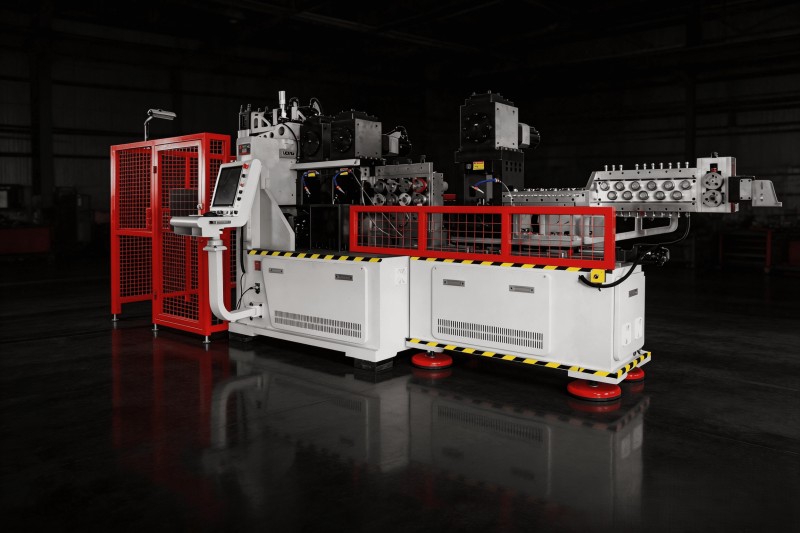
The BL-YG-12A envelope is 12000 × 2500 × 2400 mm. That is the machine body — not the space it needs.
The double-ended coil rack extends the footprint along the feeding direction: two coil positions, each rated for 1000 kg, which is where coils stop, lift and load. Add the unloading area at the discharge end, the operator side, and handling paths for dies and coils, and the real layout grows well past the drawing. Door height of 2.4 m covers the machine; it does not automatically cover a coil going up onto the rack.
You don't need a CAD station for the wiper arm production line layout step. Take a tape measure, mark the machine footprint, the rack extension and the load zones on the shop floor, and walk through a full coil-change. Whatever you bump into is what the drawing didn't show — and that walk-through is the cheapest acceptance test a wiper arm bending machine will ever get.

Where the 55.9 kW Actually Goes
The instinct is that a machine this heavy must be driven by one enormous motor. It's the opposite.
Break the 55.9 kW down: 7.5 kW × 3 for the punching stations — three presses in a row, because hole positions, slots, serrations and the logo are all done before bending, which is the whole process logic of this machine (we covered that in “Wiper Arm Bending Machine: Why Holes Come Before Bends”). Then 7.5 kW for feeding, and 4.4 kW × 2 for the rotary-bend axes that form side bends, vertical bends and twists in one synchronized stroke. No single monster motor — a series of servo groups handing work to each other in sequence.
That is also why wiper arm machine power requirements should be calculated from the nameplate total and the contract technical agreement together. The 55.9 kW figure is installed capacity; your actual supply sizing depends on duty cycles and coincidence factors, and that calculation belongs to your electrical engineer with our technical agreement in hand — not to a guess. Voltage and phases follow the nameplate; we don't answer that one in a blog post.

The Floor Holds Sixteen Tonnes — Then You Add the Coils
A wiper arm bending machine of this class weighs 16000 kg. That load lands on the base frame, which means it presses not on a floor slab but on the building itself.
A loaded double-ended rack adds up to 1000 kg per side, so the heaviest working condition approaches seventeen tonnes. Whether your concrete slab takes it, whether flatness is sufficient, whether a reinforced pad or isolated foundation is needed — that is a decision for your civil engineer together with our installation plan. I won't publish anchor bolt sizes or foundation depths in an article; those are line items we confirm project by project.
One thing you can check today: after the machine sits, the straightener scales and the die-locking adjustments sit at different heights on the frame. If the floor is uneven, levelling time doubles. Cheap to check, expensive to skip.
The Site Checklist to Send With Your PO
| Check item | BL-YG-12A reference | What you verify |
|---|---|---|
| Installed power | 55.9 kW (punching 7.5 × 3, feeding 7.5, rotary axes 4.4 × 2) | Supply sizing from nameplate + technical agreement |
| Machine weight | 16000 kg | Floor load rating, lifting or skidding method |
| Envelope | 12000 × 2500 × 2400 mm | Aisle width, door height, turning radii |
| Double-ended rack | 1000 kg per side | Rack extension in feeding direction, coil lifting space |
| Material | Flat wire 4 × 9 / 4 × 12 mm | Coil storage position and transfer path |
| Bending stroke | 500 mm | Discharge-side room for handling and inspection |
Send this table to your civil and electrical teams together with the PO. We can back every line with the corresponding technical sheet.

FAQ
How Much Power Does a wiper arm bending machine Need?
55.9 kW installed, spread across punching, feeding and rotary-bend servo groups. Whether your workshop's supply copes depends on transformer headroom — give the nameplate figures to your electrical engineer and size the supply against the technical agreement, not against instinct.
How Much Floor Space Do I Need?
The envelope is 12000 × 2500 × 2400 mm; the real space adds the rack extension, loading zones and maintenance access. As a working rule, reserve at least 1.2 × machine length along the feeding direction, then confirm on a plan view.
Does It Need a Special Foundation?
At sixteen tonnes, the foundation question goes to your civil engineer. We don't make that call remotely, but the weight distribution and foundation requirements go into the installation plan, so your engineer calculates from real numbers.
Send Us Your Workshop Layout
Rather than stopping at the gate on delivery day, send the workshop layout before you order. We will cross-check the footprint, the rack direction and the power supply condition of a wiper arm bending machine against your floor — and clear the site issues out of the quotation stage, where they cost nothing to fix.
BELAN Machinery, your expert provider of automotive wire forming solutions.